
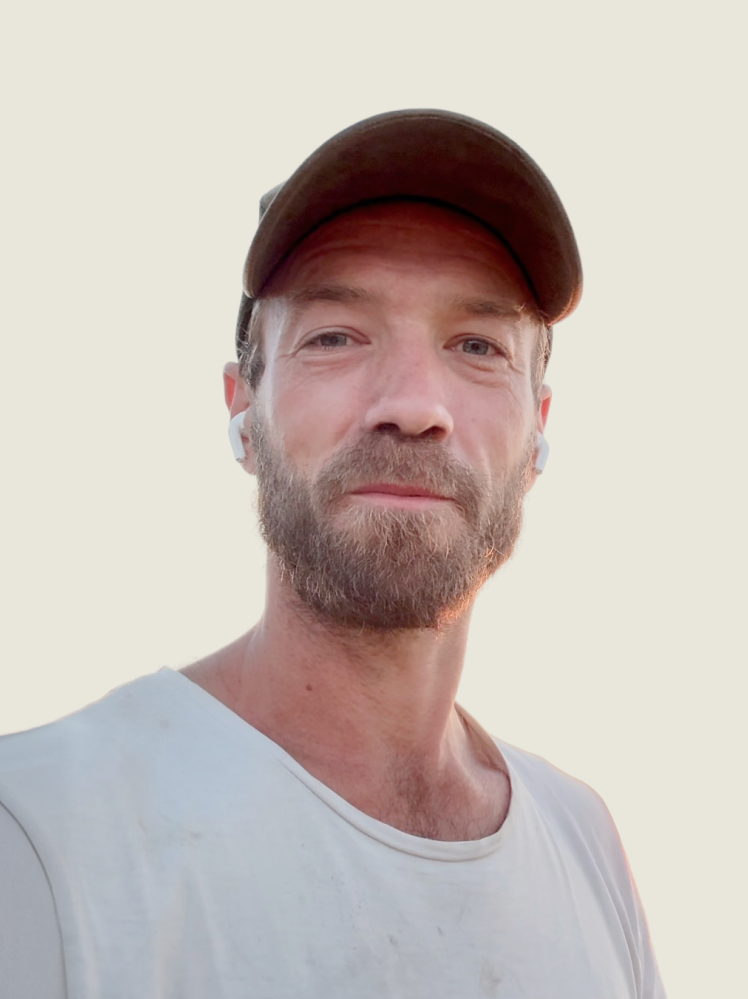

Thomas Høgsbro von Obelitz swapped a CEO desk for a chicken tractor and hasn't looked back since. His family is farming 6 hectares at the foot of a Danish castle selling out their pasture-raised eggs while drafting the blueprint to convert 120 conventional hectares into Denmark's most-watched regenerative farm.
Farm facts
Farm located in
Denmark

Hectares
6
Time invested
1-5 years
Team size
1-5
Crops
Vegetables (Open Field/ Market Garden), Grassland/ Pastures/ Hay
Animals
Cattle, Chickens, Sheep
Distribution channels
Direct to restaurants, Farm shop / On-farm sales, Online shop / website, Other
Practices
Minimising soil disturbance (no or reduced tilling), Cover cropping, Holistic grazing, Livestock integration, Composting, Rotational crop management
Certifications
None
Regenerative Journey
Free of chemical/ synthetic inputs
Revenue streams
Leaving the Office for the Countryside
At the foot of Dronninglund Slot, a former royal castle 350km north of Copenhagen, 660 chickens are working their way across a paddock of buttercups, moving to fresh grass every two days. In front of them, a small herd of cattle and a flock of sheep graze a patchwork of land.
This is Omfaun, a regenerative farm led by Thomas Høgsbro von Obelitz, a former CEO, and his wife Frederikke, a doctor, who left their professional careers to transform the land. “We wanted to create a place that not only produces food, but nourishes your soul,” Thomas explains.
Until 2024, Thomas spent his days as a successful CEO of a digital marketing agency. He was good at it, but a tiredness he couldn’t quite name kept building. “I felt this itch that I couldn’t figure out how to scratch in the city. I was great at helping my customers sell stuff online, but I craved something more meaningful.
That itch sent him down a few internet rabbit holes. He started researching how to make a living on a small-scale farm and discovered renowned experts such as Joel Salatin, Dr. Ingram, and Gabe Brown. He visited Ridgedale Farm in Sweden, run by Richard Perkins, drawn to his balance of idealism and business pragmatism. Farming, he came to understand, sits at the crux of almost every crisis that matters: biodiversity loss, soil depletion, broken water cycles, the nutrient collapse in the food we eat. “We’re not separate from nature and can extract what we need,” he says. “We’re an integral part of mother earth. She can provide us all with abundance if we let her.”
And so he and Frederikke made the leap into farming, moving with their four kids from the city to the countryside taking over 6 hectares of the 120-hectare estate owned by Thomas’s parents-in-law. They named the farm Omfaun: a Danish weave of omsorg (care), omfavn (embrace), and fauna, wildlife, and the Roman goddess of soil fertility.
From Pasture to Plate: The Eggs Putting Omfaun on the Map
Of the six hectares Thomas and Frederikke manage, 100% of the land is under regenerative management with minimal soil disturbance, cover cropping, and livestock integration. The farm includes rotational grazing of 3 cattle, 11 sheep, and 350 broilers, but its centrepiece is the 660 hens. Their eggs quickly became the farm’s signature product. The rotation happens every two days. It is simple in its logic and extraordinary in its results. The eggs have gained traction in the region for their quality, often selling out and already supplied to the top restaurants in Aalborg, Denmark’s second-largest city.
The rest is sold through the farm shop, the online store, and a REKO-ring, a Nordic model of community-supported food distribution where members pre-order directly from local producers and collect at a fixed weekly meeting point, cutting out the middlemen entirely.
After just six months under his management, tracking progress the old-fashioned way, with his eyes, camera, and a notebook, he’s already seeing results: measurably better grass growth, more biodiversity, and the early signs of a soil structure starting to come back.
“I’m still using my marketing instincts.” Thomas shares. “We focus on educating consumers about why buying regenerative matters.” The approach is working. The farm’s videos have passed 8 million views the first year. The most-watched clip is the egg rotation, moving the layers to fresh grass every two days. “We take them behind the scenes on the farm so they understand the process behind every product. It creates a deeper respect and connection,” he explains.
The 20-Year Arc
Denmark has one of the most intensively farmed landscapes in the world. Thomas sees this as an opportunity. He envisions taking over the full 120-hectare conventional estate and transitioning it to regenerative showing that farms like this, which exist all over the country, can be converted into a mosaic landscape that feeds people, restores biodiversity, and stays profitable.
Food, retreats at the castle, and estate operations would be the pillars to carry the economics. “My hope is that farmers in the area would point to Omfaun the way regenerative farmers in other countries point to Brown’s Ranch or Apricot Lane.” Thomas shares. “To get there, we need capital and more support from farm workers to customers who see the value of this way of farming.”
While Thomas’ days no longer revolve around the challenges of managing corporate clients, he faces new challenges of plumbing a water line to a paddock for the first time. Figuring out rotational fencing. Mucking out chicken tractors at dawn in a Danish November.
While none of it was what the books fully prepared him for. All of it was exactly what he’d been looking for.
Written by Top 50 Farmers and Juliana Bonnattos
Their story
The farm


