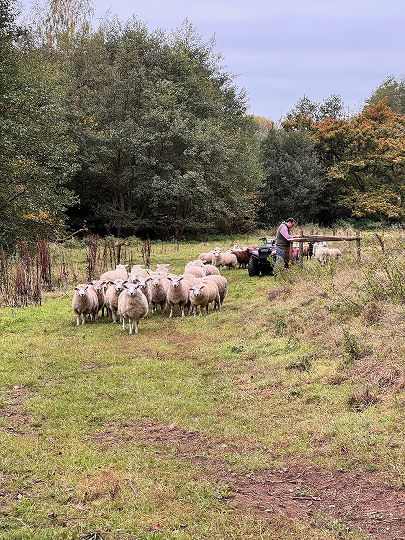
James Gillboy is rebuilding Downlands, a 280-hectare regenerative farm in Hampshire, focused on high-quality meat and egg production. A foodie, former professional rugby player, and endurance athlete, he champions the idea that the best-tasting, healthiest food starts with the soil.
Farm facts
Farm located in
United Kingdom

Hectares
280
Time invested
1-5 years
Team size
1-5
Crops
Other
Animals
Cattle, Chickens, Deer, Pigs, Sheep, Turkeys
Distribution channels
Direct to restaurants, Online shop / website
Practices
Minimising soil disturbance (no or reduced tilling), Livestock integration, Others
Certifications
Regenerative Organic
Regenerative Journey
Free of chemical/ synthetic inputs
Revenue streams
A Blank Canvas in Hampshire
In 2024, James Gillboy’s family took on Downlands, 280-hectares in Bramshott, Hampshire, around 30 miles from central London. While established in 1550, Downlands hadn’t been farmed for 20 years. Fields had rotten fences. Farm buildings had been sold off. The soil was naturally infertile and prone to drought. There were no animals. “It was daunting,” says James, “The farm’s most recent life had been as a pheasant shoot and hay production, but we saw the opportunity for it to become much more.”
James knew he wanted to work the land since he was seven years old. At a neighbor’s farm, he regularly pulled lambs from struggling ewes. “If you would have asked me what I wanted to be when I grew up, I’d have said Farmer, no question,” he recalls. But his path into farming was anything, but direct. Downlands gave him a chance to get back to his childhood dream.
James was introduced to regenerative practices during a hiking trip with his father through the Pyrenees where a local shepherd explained how local wildlife and livestock were integral to the health of the mountains, and how the French government supported shepherds to maintain natural landscapes. James came back home inspired and started to research. He watched YouTube videos, read Gabe Brown’s Dirt to Soil, joined WhatsApp groups with UK regenerative farmers. Until, one video brought everything into focus.
“The moment I watched Joel Salatin on YouTube, I knew I wanted my farm to be like this,” James says. American farmer and author Joel Salatin, widely credited with making regenerative agriculture accessible to a new generation, was the person James was looking for. “He was the role model that made me see what farming could be. Producing excellent quality food whilst improving our environment and connecting with the people eating the produce’’
If You Love Food, You Have to Care About Farming
James is a foodie. Long before he became a farmer, he cared about what went on the plate and why it tasted the way it did. “I did professional rugby for 5 years and compete as an endurance athlete at events globally.” James explains. “But beyond that, I love food. If you like high quality ingredients, nature, and the countryside then this kind of farming just makes sense,” he says. This love for great taste is at the heart of Downlands production today.
On the farm, everything is intentional and carefully curated. Every animal has a job supporting the health of the whole and conditions the land for the next. “By producing smaller numbers, but at much higher quality, and with greater variation in species, we create a system where all the animals work together in their own ways,” he explains.
In practice, chickens follow the cattle, eating fly eggs and larvae and breaking the pest cycle; pigs eat fallen apples; sheep graze after the chickens. Downlands is one of the first farms in the UK to do pasture-raised egg operation at scale with 2,500 chickens working the land.
“I really love taking people on tours and showing them how what we’re producing is not only good for the animals, but good for the environment.” James shares.
James is also a Director of The Ethical Butcher, a direct to consumer company selling regenerative meat. He believes that businesses like this one, largely owned by farmers, can help revitalize the farming industry by investing in communication between farmer and end customer. James is working to change the supply chain from the inside out. “Farmers alone cannot normalize regenerative farming,” he says. “The entire supply chain has to do what’s best for people, animals and the planet. I see our job as creating a professional, marketing savvy operation that makes it easy for them to start selling regenerative produce.”
Writing the Next Chapter
James’ vision for Downlands over the next 10 to 20 years is to promote pasture-raised eggs, convert all pasture to species-rich grassland, native wildflowers, clovers, grasses, creating wildlife habitat while producing the finest beef, woodland pork and lamb. He wants Downlands to be a farm people point to when they need proof that regenerative agriculture works at scale. “Ultimately, I want to write a book on how to transition to the next generation of agriculture.” James shares.
James knows the value of regenerative role models. Seeing and learning from Joel Salatin and Gabe Brown gave him a roadmap for stepping into regenerative farming. This is also why he joined Top 50 Farmers.
After building Downlands from nothing, he is doing exactly what others did for him: showing people what is possible, one farm tour, one extraordinary ingredient, and one conversation at a time. “Farming isn’t just a business, it’s a way of life.” James shares. “Through good food and marketing, we help others see why this way of eating is the future’’
Written by Juliana Bonatto
Their story
The farm