
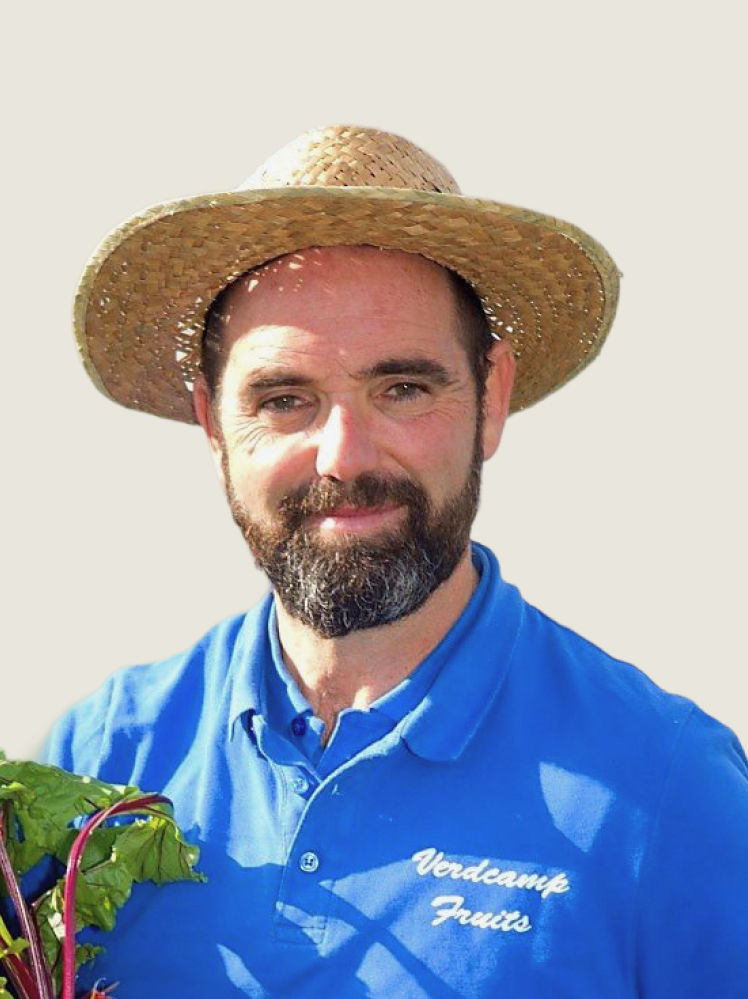

Ernest Mas leads innovation at Verdcamp Fruits in Tarragona, Spain, combining a 90-year family farming heritage with cutting-edge agroecology to demonstrate that large-scale organic vegetable production can be ecologically restorative and thrive economically.
Farm facts
Farm located in
Spain

Hectares
300
Time invested
21+ years
Team size
100+
Crops
Vegetables (Open Field/ Market Garden), Olive groves
Animals
Bees
Distribution channels
Wholesaler, Direct to retailer, Online marketplace/ platform, Other
Practices
Minimising soil disturbance (no or reduced tilling), Cover cropping, Composting, Rotational crop management, Others
Certifications
Organic
Regenerative Journey
Free of chemical/ synthetic inputs
Revenue streams
Rooted in tradition, driven by innovation
For Ernest Mas, farming isn't just a job; it’s in his blood. His family's agricultural roots in Cambrils, Tarragona, date back to 1933 at Masia Barrabeig. After studying organic farming at the University of Barcelona, Ernest returned to run the business alongside four of his cousins, bringing a fresh perspective to their shared legacy. Facing the economic pressure of competing strictly on price, they made a bold pivot toward ecological, high-value agriculture.
"Faced with the impossibility of competing on price, we are committed to adding value to our production by converting to organic and sustainable agriculture." Ernest explains.
Over the last 15 years, Ernest has turned the family farm into a living laboratory for agroecology. As Ernest explains “We manage 300 hectares of vegetable crops across more than 50 farms; we have been practicing organic farming for over 15 years and are now transitioning toward regenerative agriculture or farming that is as natural as possible. Our aim is to cultivate the landscape to produce food.”
Instead of relying on synthetic pesticides, Ernest and his team plant continuous floral strips directly alongside crop rows to harbor beneficial insects that hunt pests naturally. Ernest says “We also employ techniques such as floral intercropping - an innovation we introduced over a decade ago - which involves planting flowers amidst our crops. By planting them simultaneously and synchronizing the entire process, we break up monocultures and foster the beneficial fauna and biodiversity needed to keep pest populations in balance. We also create environments that support pollinators and bees.”
Through their Healthy Crops & Bee Happy initiative, the farm creates habitats for wild native pollinators rather than importing managed hives, while actively encouraging populations of bats and birds to act as natural pest managers. "Our vision has changed so much that we've changed our perspective on what, for example, we used to call weeds. Now they are key plants for improving our biodiversity." he shares.
To eliminate plastic mulch, a common challenge in organic horticulture, Ernest collaborates with the University of Barcelona on Europe’s largest field trial testing green mulches flattened with a roller crimper. By planting cover crops like barley, vetch, and phacelia and rolling them into protective soil blankets, they suppress weeds, build organic matter, conserve moisture, and improve soil structure. From historically raising just three or four crops, Verdcamp Fruits now cultivates over 20 diverse vegetable varieties in balance with the ecosystem.
Proven business model for ecological scale
Operating a major enterprise with over 100 employees, harvesting 11 to 12 million kilograms of produce annually, and generating over €10 million in revenue proves that doing right by the earth makes solid business sense. "Our product means nothing if it is not cultivated in harmony with the land and its surroundings," Ernest insists.
Historically, 70% of their harvest was shipped across Europe. Today, Ernest has flipped that ratio: 70% of their produce now stays in Spain to support local supply chains and reduce transport emissions. "We need food from nearby, not food that travels around the world!" he argues.
The farm pairs ancient biological wisdom with modern precision technology. Verdcamp Fruits was a pioneer in 2017 by calculating and verifying water and carbon footprints across ten crops, using satellite tracking, and soil sensors to optimize irrigation.
The operation features a circular waste management model, uses rooftop solar panels to generate 60% of its facility's energy (with the remainder from renewable sources), and utilizes electric vehicles. Recognized with BBVA's Extraordinary Award for Best Sustainable Producer in Spain, Ernest continues working toward a fully organic, low-footprint model.
Community, advocacy, and knowledge sharing
Ernest lives by a simple rule: sharing is also sowing. He believes that trial and error are natural parts of progress - "Mistakes lead to learning, and that is the path to success." - and actively shares both triumphs and failures with the broader agricultural community. "Our intention is to share all our innovations and experiences with the widest possible community and to give value to our agriculture," he notes.
Verdcamp Fruits regularly opens its doors for technical transfer days, educational visits, and university research projects, while donating surplus produce to regional food banks and partnering with organizations like the Red Cross and UNICEF. Beyond field trials, Ernest uses social media to showcase real-world results to fellow growers, aiming to bridge the divide between urban consumers and rural producers. He strongly advocates for structural societal support, "I believe that the main factor that could turn some of the stress into extra motivation is the concept of value in the eyes of society. If society in general saw farmers as valuable and beneficia, and if genuine political alliances were created to support this type of agriculture, it would be very positive."
A hopeful vision for the future of agriculture
At its heart, Ernest Mas’s work represents a viable path forward for European agriculture - one where ecosystem restoration and commercial productivity go hand in hand. Joining the Top 50 Farmers serves as another step in amplifying this message of practical hope. "A very important reason for applying is to continue spreading the message that doing things differently - farming in a more sustainable, organic, regenerative way - is possible and can be a success both for us and for our planet," Ernest reflects.
By turning his family's coastal fields into a resilient, biodiversity-rich landscape, Ernest isn't just growing vegetables for today; he is demonstrating a working model for future generations of growers across the continent. "My hope is that in 10 or 20 years we will have inspired many people to change the way they produce food and how they relate to what they consume and those who grow it."
Over his 21 years in the fields, he has remained deeply tied to his hometown while completely transforming how they grow food. "We are farmers. We are here on the land. We are rural, and we are very proud of it," Ernest emphasizes.
Written by Top 50 Farmers and Angelo Tarquini
Their story
The farm


