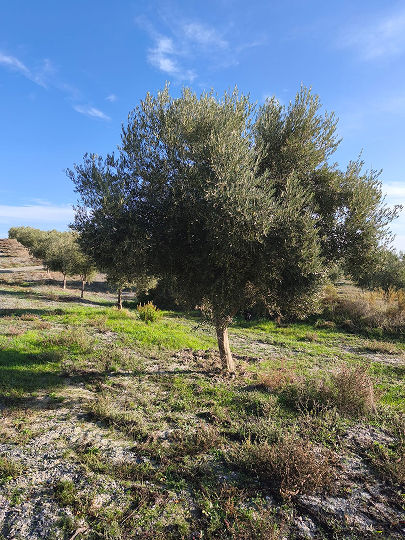
In the semi-arid highlands of Granada, Maikel Lara Valera transformed his family's 50-hectare farm into a working example of regeneration in one of Spain's most challenging climates. Farming olives, almonds, and Segureño lamb, he's proving that even the driest land can come back to life.
Farm facts
Farm located in
Spain

Hectares
50
Time invested
21+ years
Team size
1-5
Crops
Olive groves, Other
Animals
Sheep
Distribution channels
Direct to retailer, Direct to restaurants, Online shop / website, Cooperatives
Practices
Minimising soil disturbance (no or reduced tilling), Cover cropping, Agroforestry/ Reforestation/ Rewilding, Livestock integration, Composting
Certifications
Regenerative Organic
Regenerative Journey
Free of chemical/ synthetic inputs
Revenue streams
Land Pushing Back
Maikel Lara Valera has spent over two decades tending his family's 50-hectare farm in the semi-arid highlands of Granada. These days, when he walks across the land to attend to his 50 sheep or the olive and almond trees they graze beneath, his steps are increasingly cushioned by soft, living soil.
It wasn't always this way. For most of those years, Maikel farmed the land the same way everyone else in the region did.
"I used to practice traditional farming on these same lands. It was what everyone did," he explains. "But there came a moment when I realized something wasn't right. The semi-arid soils on my land would form a crust, and when it rained, this crust prevented the water from penetrating the soil."
The land was telling him something was wrong. "My land had a lot of erosion. It was hardened. It didn't absorb water. That pushed me to look for new solutions."
The Soil Answers
Roughly a decade ago, Maikel set out to find a different way. Without local mentors and with no established regenerative community in his region, he taught himself.
"I began reading and studying. Through this self-study, I realized the problem was the type of agriculture we were practicing. So, we switched to regenerative agriculture," he says.
He introduced cover crops. His sheep began to graze amongst the olive and almond trees. He minimized tilling and started composting. His neighbors took notice, but not in the way he might have hoped.
"In the beginning, it was difficult. Change requires effort and not everyone is willing to invest the energy needed, especially when they are comfortable with what 'works' for them. That's why at first I faced a lot of resistance from the community and people even called me crazy," Maikel explains.
Despite resistance within the community, he kept going. Slowly, the soil began to respond, and the rest of the farm reaped the benefits.
"Now, my soils are able to absorb rainwater. They feed my sheep and my olive trees are producing olives of a quality we never even dreamed of before," he says, referring to the internationally sought olive oil he now produces.
The results were undeniable enough that the neighbors who once called him crazy began asking how he'd done it.
"Nobody would have bet on this semi-arid land to regenerate the soil, and having succeeded in doing so makes my farm truly unique," he explains proudly.
A Farm That Works Like Nature
At the heart of Maikel's approach is a conviction that farming should imitate, not fight against, the natural systems it depends on.
"The industry separated animals from the farm land. They put the animals to one side, the cultivated fields to another,” Maikel explains of the traditional farming industry. “But everything has to come together, everything has to work together in a full circle. There's nothing better than imitating nature because nature is the wisest of all."
That philosophy shapes every part of the farm's operation. His 50 sheep aren't just a separate enterprise producing Segureño lamb; they graze beneath the olive and almond trees, integrating livestock with tree crops in a closed loop that feeds both. The olive oil is sold direct to retailers, restaurants, online, and through cooperatives. The farm now functions as a system.
The community Maikel couldn't find locally when he started has started to take root. He's part of a network of regional and international regenerative organisations, including Alvelal, Aregenerar, Pasture Plus, Commonland, Fundación Aland, and the Regeneration Academy. Through them, he's connected with farmers across Spain and beyond who share what they're learning and support each other through the challenges of the work. This is also why he is excited to be part of Top 50 Farmers.
"I feel proud to have brought this concept to my region," he says. "When I started, nobody knew about it. Afterwards, the same neighbors and fellow farmers who once thought I was crazy for letting grass grow among my crops began asking me how they could implement the same practices in their own fields. Now, more and more local people are showing interest and people from other parts of the world come to see what we are doing."
A Region, Regenerated
Maikel's vision for the future is as tied to nature as his approach to farming.
"In twenty years, when I walk through my farm at dawn, I want to feel that all this effort has borne fruit. I imagine stepping onto dark, rich, living soil; soil that no longer resembles the poor, degraded land of the Granada highlands where I began."
He dreams of cover crops that grow spontaneously each autumn, of sheep grazing calmly beneath olive and almond trees, of an ecosystem functioning on its own. More insects, more birds, more pollinators, more fungi. More life in every corner.
But the vision extends beyond his own land. Today, the cooperative he's part of includes 22 small farmers. In twenty years, Maikel wants to see it many times larger. This dream isn’t borne from ambition, but because the more farmers who join, the greater the collective impact on a region that has, for decades, been dismissed as too arid and too depopulated to recover. Being part of Top 50 Farmers, he hopes, will help him find and learn from others walking a similar path.
"I would love to see what other farmers have done in different parts of the world, what challenges they faced, and how they overcame them," he says.
For Maikel, that's the real measure of success. Not just soil that breathes on his own farm, but a way of farming that spreads across the Granada highlands, one neighbour at a time. “I want to see a human network as alive as the web of life in the soil,” he explains.
"I imagine a region no longer seen as a dry, struggling plateau, but as an example for other semi-arid areas that today believe there is no way forward,” he says of his continued path forward. “In my vision, the Granada highlands are a regenerated territory thanks to hundreds of small changes that, together, created a profound transformation. I see a living farm, a strong cooperative, a regenerated region, and an agricultural culture that understands the future is only possible if we regenerate the land that sustains us.”
Written by Top 50 Farmers and Isabel Duncan
Their story
The farm