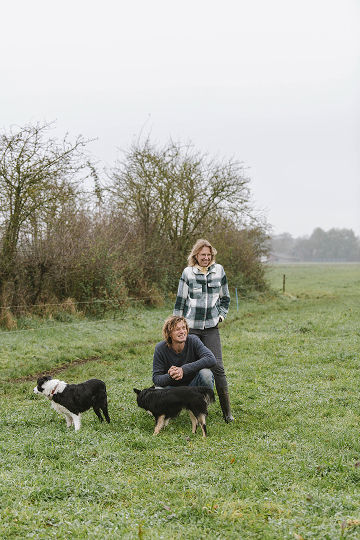
Near the Dutch-German border, Gerjo Koskamp stewards a 46-hectare biodynamic regenerative dairy farm that integrates ethical food production, biodiversity restoration and community education into a resilient farming model.
Farm facts
Farm located in
Netherlands

Hectares
46
Time invested
21+ years
Team size
1-5
Crops
Cereals/Grains, Vegetables (Open Field/ Market Garden), Fruits, Nuts, Grapes / Vineyards, Herbs/ Spices/ Medicinal Plants, Flowers, Grassland/ Pastures/ Hay
Animals
Cattle, Chickens, Donkey, Horses, Pigs, Sheep
Distribution channels
Wholesaler, Direct to retailer, Direct to restaurants, Farmers markets, Farm shop / On-farm sales, Online shop / website
Practices
Minimising soil disturbance (no or reduced tilling), Cover cropping, Agroforestry/ Reforestation/ Rewilding, Holistic grazing, Livestock integration, Composting, Rotational crop management, Others
Certifications
Demeter
Regenerative Journey
Free of chemical/ synthetic inputs
Revenue streams
Going Against The Grain
Gerjo Koskamp has spent his life challenging what dairy farming could be. Growing up on the same farm he now owns, he witnessed conventional dairy production firsthand, but even as a child he felt something wasn’t right. “I could not explain it as a child, but I felt deeply that the way we farmed did not match what I instinctively understood as a healthy relationship between people, animals, and the land. Because of that, I never imagined becoming a farmer,” he reflects.
Convinced he couldn’t follow in his family’s footsteps he enrolled at agricultural university with plans to pursue plant breeding instead. It was there that everything changed. “During my studies, I discovered that farming could be done differently and that it was possible to work alongside nature instead of constantly pushing against it. That realisation opened a door in me that never closed again,” Gerjo explains.
When the opportunity came to take over the family farm he agreed on the condition that he could transform it entirely. “Of course this was met with some resistance from my family at first, but in the end they embraced it too,” he adds. Now Boerderij Ruimzicht is a 46-hectare biodynamic regenerative farm near the Dutch-German border built on living soils, animal dignity, and collaboration with nature. The same principles that inspired him decades ago continue to guide the farm today. “What I’ve noticed is that it gives so much job satisfaction when we work the way nature intended.”
Rethinking Dairy
Over the last 21 years Gerjo has transformed the land that has been passed down through 3 generations of his family. When he took over the soil was tired, biodiversity was low, and the landscape functioned mainly as a production space. Rather than treating soil, livestock and crops as separate entities, he rebuilt the farm as one interconnected living system.
“I set out to create a place where nature sets the rhythm, animals live with dignity, and where biodiversity guides every choice. Here, the soil is treated as a living partner rather than a resource.” he explains.
Regeneration began from the ground up, restoring soil health through composting, diverse pastures, and a closed-loop farming system where nutrients are continually returned to the land.
The transformation is perhaps most visible in the way animals are cared for. Unlike conventional dairy systems, where calves are commonly separated from their mothers within 24 hours of birth to maximize milk that can be sold, Boerderij Ruimzicht utilizes mother-bonded calf rearing. Calves remain with their mothers, bulls are not castrated, family herds are maintained and natural breeding is encouraged. Beyond improving long-term health and supporting stronger immune systems, these practices allow cattle to maintain their social bonds.
The results are evident across the land.
Biodiversity is flourishing, the soil is rich in life and fertility, and every product leaving Boerderij Ruimzicht is Demeter certified. As Gerjo says, “By following the logic of nature and recognizing that we are part of it ourselves, we have created a regenerative, life-centred farming system that goes far beyond common practice."
The Farm That Invites You In
While the sale of dairy products, fruit and vegetables from the market garden remain central to the business, Gerjo has intentionally developed multiple complimentary income streams that strengthen Boerderij Ruimzicht’s long-term resilience. Guided tours, cheese-making workshops, culinary experiences and seasonal community events contribute to the farm’s financial sustainability, reducing its reliance on food production alone while allowing more people to experience regenerative agriculture firsthand.
Rather than viewing these activities as separate enterprises, Gerjo sees them as an extension of the farm’s purpose. “We are a place where people can spend time, connect with nature, and see where their food truly comes from," Gerjo explains. Every visitor experience is designed to bridge the growing gap between consumers and the landscapes that nourish them, transforming the farm into a space of learning as much as production.
Visitors are invited behind the scenes to experience every aspect of the farm. Guided tours take guests through the barns, cheese factory and aging cellar, market garden, meadows and grazing pastures. Along the way, Gerjo shares how biodynamic and regenerative farming principles shape every decision from soil management and biodiversity to animal welfare and food production. Rather than simply telling people about regenerative agriculture, he allows them to experience it through the sights, smells, and rhythms of the farm.
The experience continues around the table through the farm’s “Boer'nTafelen” (Farmer’s Table), where seasonal meals showcase the food produced on the farm itself. Fresh cheeses, wood-fired pizzas, homemade dairy desserts, create a menu that changes throughout the year according to what the land provides. In doing so, visitors experience not only the flavours of regenerative agriculture but also the close relationship between healthy soils, thriving ecosystems and nutritious food.
Looking ahead, Gerjo hopes to further strengthen both the farm’s educational mission and financial resilience through the development of a small regenerative agro-tourism campsite. Designed as a nature-inclusive retreat, the campsite would invite visitors to immerse themselves in the daily farm life, thereby developing a deeper appreciation for the people and landscapes that sustain them.
Knowledge Is Action
Gerjo believes that meaningful change in agriculture happens when knowledge is shared openly and communities are invited to experience farming first hand. “We hope to inspire others, offer practical knowledge, and show that regenerative farming can be a meaningful and realistic way forward for both agriculture and society.” Through regular guided tours, workshops and the farm’s “Ruimzicht op de Melkweg” (Panoramic view of the Milky Way) festivals, bringing together music, local food, camping and farm experiences, thousands of visitors have been introduced to a different vision for agriculture, one that reconnects people with the landscapes that nourish them.
Gerjo’s commitment to education also reaches well beyond the farm gate. He is regularly invited to speak at workshops and gathering’s, including events hosted by Caring Farmer’s, where he shares practical knowledge on biodiversity, animal-centred dairy systems and farming in harmony with natural cycles. As an advocate for mother-bonded calf rearing, he co-founded the initiative Kalfjes bij de Koe (Calves with the Cow), combining scientific research with farmers’ lived experience to help Dutch dairy producers transition towards more ethical livestock management. Thereby creating viable markets for milk produced under higher welfare standards, ensuring farmers who choose to invest in animal-wellbeing are fairly rewarded for their work.
Despite the growing recognition of regenerative agriculture, Gerjo remains clear about where his priorities lie. “The methods we use are not the ones that maximize revenue. We prioritise maintaining nature, ensuring true animal dignity, and producing healthy, honest food. For us, financial gain cannot come at the expense of the land, the animals, or the integrity of the food system.” For Gerjo, “Every decision we make is guided by regenerative principles; building living soil, supporting biodiversity, caring for animals with respect, and creating a resilient farming system that strengthens both our land and our community.” Through his farm, his advocacy and his willingness to challenge convention, Gerjo is helping demonstrate that the future of dairy farming can be measured not only by what it produces, but by what it restores.
Convention vs Conviction
More than two decades after transforming his family’s dairy farm, Gerjo believes the future of regenerative agriculture depends on making it economically viable for the farmers willing to lead the transition. He wants regenerative farmers to feel empowered to choose nature without sacrificing their livelihoods. “Reducing financial stress is essential for creating a truly sustainable farm system: one where the land, the animals, and the farmers themselves can thrive.” Yet despite the challenges, his optimism remains unwavering. This is also why he is happy to be part of Top 50 Farmers sharing his story with others and role modeling what’s possible.
“I dream of our farm serving as an example for others, not through perfection, but through authenticity and commitment. If we can inspire other farmers to trust their instincts and take steps toward more nature-inclusive practices, then our impact becomes much larger than our land alone.” he shares.
Looking to the future, Gerjo’s vision extends far beyond the boundaries of Boerderij Ruimzicht. “My deepest hope is that in 10 to 20 years, our farm will stand as a living example of what becomes possible when collaboration, respect and care form the foundation of agriculture.”
In many ways, that future has already begun. His farm demonstrates what’s possible when conviction outweighs convention and when the health of animals, people and land become the measure of success. “Looking back, I know that regenerative farming did not come to me as a trend or a technique. It came as a calling.”
Written by Top 50 Farmers and Marie Lehmann
Their story
The farm