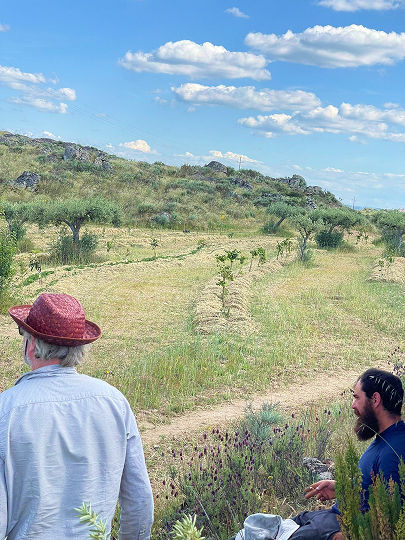
John Broad is demonstrating how syntropic agroforestry can reverse desertification by transforming degraded, fire-prone land in northeastern Portugal into a thriving ecosystem. Building on a proven model developed in Brazil, Scave Portugal combines ecological restoration, scientific measurement, and community engagement to create a replicable blueprint for regenerating Mediterranean landscapes at scale.
Farm facts
Farm located in
Portugal

Hectares
180
Time invested
6-10 years
Team size
1-5
Crops
Fruits, Nuts, Olive groves, Biomass / Energy crops, Other
Animals
None
Distribution channels
Other
Practices
Minimising soil disturbance (no or reduced tilling), Cover cropping, Agroforestry/ Reforestation/ Rewilding, Rotational crop management, Others
Certifications
None
Regenerative Journey
Free of chemical/ synthetic inputs
Revenue streams
From Luxury Hotels to Syntropic Agroforestry
John’s interest in the power of nature to create change began in childhood. He grew up in Madeira, the lush Atlantic island located 1,000 kilometres southwest of mainland Portugal.
"I was surrounded by role models who respected and protected the land," John explains. Among them was his grandfather, founder of Madeira’s Nature Museum.
As a young man, John spent six years working as a scuba diving instructor and guide in Madeira’s underwater nature parks, developing a deep and practical understanding of complex ecosystems. An avid traveller, he later spent a decade managing luxury hotels and another ten years managing a real estate fund in Brazil. "While I had an international career, I always maintained a foundational bond with the living world," he recalls.
John’s return to regenerative agriculture began when he started searching for locally grown organic food and found it surprisingly difficult to access. Curious, he enrolled in an introductory course on syntropic agriculture. "It was a revelation," he says.
While continuing his corporate career, John spent the next two years studying syntropic agriculture and building a small living laboratory in his garden. He also travelled extensively across Brazil to learn directly from some of the field’s leading practitioners.
Starting on Brazilian Soil
John’s serious foray into regenerative agriculture began when he and his partner purchased land in São Miguel do Gostoso in northeastern Brazil.
They transformed five hectares of land degraded by overgrazing and heavy machinery into a thriving syntropic agroforestry system centred on crops native to the region, including coconut, mango, lime, and pineapple. The farm demonstrated that ecological restoration and food production can work hand in hand.
The Brazilian farm soon became a hub for education and community. Over time, it welcomed more than 600 alumni from around the world. "We funded full scholarships for over 200 local, low-income farmers," John says. "We wanted to make it easy and accessible for all kinds of farmers to learn this method."
A direct-to-home produce delivery service supplied fresh food to fifty families each week. Farmers' markets brought together producers, artists, and chefs. Alumni from the farm went on to establish 350 hectares of agroforestry systems nearby, while policymakers who visited the project helped secure official recognition of agroforestry as an accepted reforestation approach.
Seeing the scale of transformation that was possible, John decided to bring the model back to Portugal. "We knew the land and climate would be different, but the work would be the same: adapting a successful model to the Portuguese landscape while regenerating land and building resilient, community-oriented food systems."
This was the beginning of Scave Portugal.
A Green Beacon in the Hills
Scave Portugal spans 180 hectares on the edge of the village of Cidadelhe, near Pinhel, where fewer than forty people live.
When John arrived, the land was depleted, fire-prone, and steadily losing its battle against desertification.
Once vibrant with vineyards and orchards producing apples, pears, and peaches, the landscape had suffered decades of monoculture grain production that depleted the topsoil and weakened ecosystem function. For years, the land had been mechanically cleared annually to qualify for fire-prevention subsidies, leaving behind a sun-baked and biologically inactive landscape.
John was familiar with Brazil’s fertile soils and tropical heat, but Portugal presented an entirely different challenge. The site experienced months of frost, extended periods of drought, and severe wildfire risk. There was no irrigation infrastructure and little remaining soil fertility.
Yet by applying the same universal principles of syntropic agriculture to a vastly different climate, results began to emerge quickly.
On a two-hectare pilot plot, the team established more than 25,000 plants, including 900 productive fruit trees and 8,000 support species, alongside cacti, cuttings, and a dense succession of plants designed to accelerate ecological recovery through biomass production and soil building.
"The result is already visible and undeniable," John says. "This pilot area is thriving and alive in a way the rest of the region isn't yet. It stands as a green beacon against the older, dusty monoculture blocks."
Driven to demonstrate measurable ecological impact, John partnered with Dr. Walter Steenbock, a leading agroforestry scientist, to implement a rigorous monitoring, reporting, and verification (MRV) system. Soil health, biomass production, water retention, and biodiversity are all being tracked across the living laboratory. The goal is not simply to farm successfully, but to generate the scientific evidence needed to accelerate adoption and influence European agricultural policy.
This ambitious effort is powered by a growing network of supporters: regenerative farmers, former students from Brazil, volunteers who became team members, and a committed landowner who shares the vision of restoring the landscape. "Everyone on the team brings their contribution," John says. "That's what makes it such a rewarding project."
The 20-Year Arc
John is not building a single farm. He is building a replicable, evidence-based model for reversing desertification across Mediterranean Europe. Having witnessed the ripple effects of regeneration in Brazil, he believes similar outcomes are possible in Portugal. "Our journey proves that profound, positive change is possible," he says. "Scave Portugal is the culmination of that journey."
Within ten to twenty years, John envisions Scave Portugal as a mature and self-sustaining food forest spanning the entire 180 hectares. The landscape would not only withstand drought and wildfire pressures but actively reverse desertification while supporting local livelihoods. Future plans include processing facilities for olive oil, essential oils, cork, hazelnuts, and citrus products, alongside restored stone buildings converted into cabins, classrooms, and learning spaces.
"I'm happy to be part of Top 50 Farmers and connect with other farmers who understand the hard work, perseverance, and dedication this path takes," John says. "The impact is worth it."
Written by Top 50 Farmers and Juliana Bonnattos
Their story
The farm