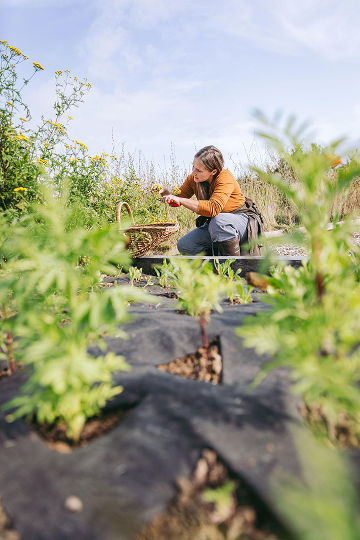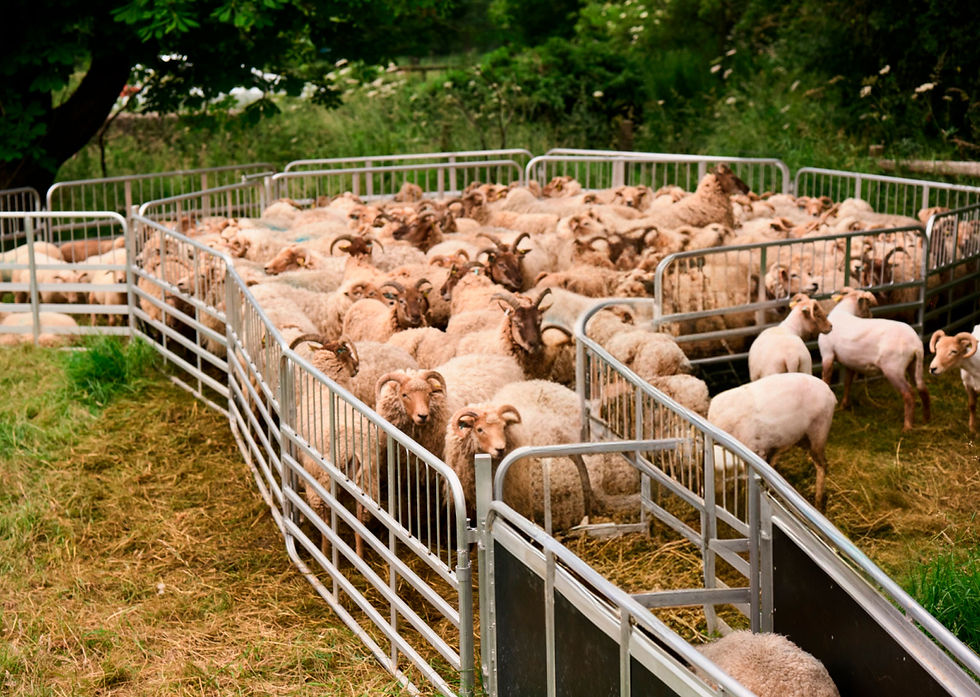


Former graphic designer Katie Allen found her way to farming after recognizing that both the food we eat and the clothes we wear begin on the land. At The Great Cotmarsh Farm in Wiltshire, she now stewards 69 hectares through grazing and agroforestry, bringing the farm-to-wardrobe connection to life.
Farm facts
Farm located in
United Kingdom

Hectares
69
Time invested
11-15 years
Team size
1-5
Crops
Flowers, Grassland/ Pastures/ Hay, Other
Animals
Cattle, Pigs, Sheep
Distribution channels
Wholesaler, Direct to restaurants, Farmers markets, Farm shop / On-farm sales, Online shop / website
Practices
Agroforestry/ Reforestation/ Rewilding, Holistic grazing, Composting, Others
Certifications
Organic, Pasture For Life
Regenerative Journey
Free of chemical/ synthetic inputs
Revenue streams
Making Farming Fashionable
Katie Allen is on a mission to make farming fashionable. As a graphic designer in her late twenties, she found regeneration after questioning the root of the products she consumed. “I became interested in farming after realizing that the food we eat, clothes we wear, and products we put on our skin all start on the land,” she shares.
She got curious and started to learn more. Inspired by a head farmer at Daylesford Organic, she started reading about organic farming, completed two short courses, and took action by growing vegetables and keeping chickens in her own small garden.
That thread of curiosity, once pulled, didn’t stop.
Katie’s first farm was a smallholding in Cornwall where she converted the land to organic, starting a market garden and getting her first sheep in the process. Katie remembers the bemused looks of neighbouring farmers when she sowed a herbal ley in her fields.
Katie then made the decision to move closer to James, who is now her husband, and although they did not have access to land, she found another way to feed her curiosity and passion for farming.
For years, Katie and James ran a conservation grazing service across the Cotswolds, taking their native breed cattle and sheep to Wildlife Trust sites, floodplain meadows, and arable cover crop fields—anywhere that needed animal impact and didn’t have livestock of its own. It was an unusual apprenticeship: learning to farm without owning a farm.
To further her knowledge, she completed the Holistic Farm Management training with 3LM. This changed the way Katie saw the land. “I went from seeing the land as a patchwork of habitats and fields to look after to one big, living, breathing ecosystem. I understood how every small action that we make could have a transformative and profound impact on something that we hadn’t even thought about.”
The Transformation: Great Cotmarsh Farm
In 2023, Katie and James took on Great Cotmarsh Farm, a 69-hectare farm set in the rolling North Wiltshire countryside. Before they took it over, the farm had been run as a conventional dairy operation, with set-stocking, heavy slurry applications, and herbicide use. The soils were depleted, with high nitrogen levels in the grassland, which created calcium deficiency at lambing in the first two years.
“When we took over the farm, I knew that we were going to come onto the farm and completely transform the management of the land overnight,” says Katie. And they did.
They introduced rotational grazing with frequent moves and long rest periods. They sowed a wildflower meadow with legumes and chicory, plants that remained resilient even through the drought of 2024. “When other local farmers were out of grass in the drought, our cows were diving into forage above their heads,” Katie says.
Barn owls are now breeding on the farm, a sign that field voles, their main source of food, have found a home in the habitat Great Cotmarsh Farm provides.
New species are arriving in the pastures: bird's-foot trefoil, knapweed, and late autumn hawkbit. Katie has learned to trust the process and is confident in the power of nature. “I gained the confidence and belief to trust the journey and have faith in the power of nature,” she says.
There is more to come.
In partnership with the Woodland Trust, Great Cotmarsh Farm is planting 6,500 trees across three seasons. “These trees are vital to ensure our farm is climate resilient in the future,” says Katie. “They will improve the habitat diversity on the farm, support the water cycle, and add greater variety to the diet of the livestock.”
The Thread Back to Fashion
Great Cotmarsh Farm is one of a kind: it bridges the world of farming with fashion. Katie has built a knitwear brand from the farm’s own wool, selling items through an online shop and at the farm. A tannery is opening soon, offering fully traceable leather from the farm’s own cattle hides. Botanical dyes are grown in the fields.
“We are what makes our farm unique,” she says. “The passion and knowledge we bring to fashion, fibre and the soil is unique.”
Katie shares this passion with her community. In just six months, the farm has hosted more than 300 visitors, from primary schoolchildren to fashion and design students at degree level. “Getting the students here on the farm, digging soil, seeing worms, seeing the birds interacting with our hedgerows, it really helps them to understand the impact of their decisions on materials, on the land, and on the environment,” she says. “It gives them a bit of hope and empowers them to make positive decisions as designers.”
Katie has made remarkable progress at Great Cotmarsh Farm, but even in these moments, imposter syndrome sneaks in. Katie almost didn’t apply for Top 50 Farmers, but the drive to connect with others and take risks for the betterment of the environment and the community won out over the doubts.
“Peer-to-peer knowledge, that education, that engagement is how we’re going to really make change,” she says. “Policy is important, but people on the ground are the ones that can really improve things for the better.”
The thread that first tugged at Katie in that shop is still pulling, and at Great Cotmarsh Farm, it’s always weaving something new.
Written by Top 50 Farmers and Juliana Bonatto
Their story
The farm