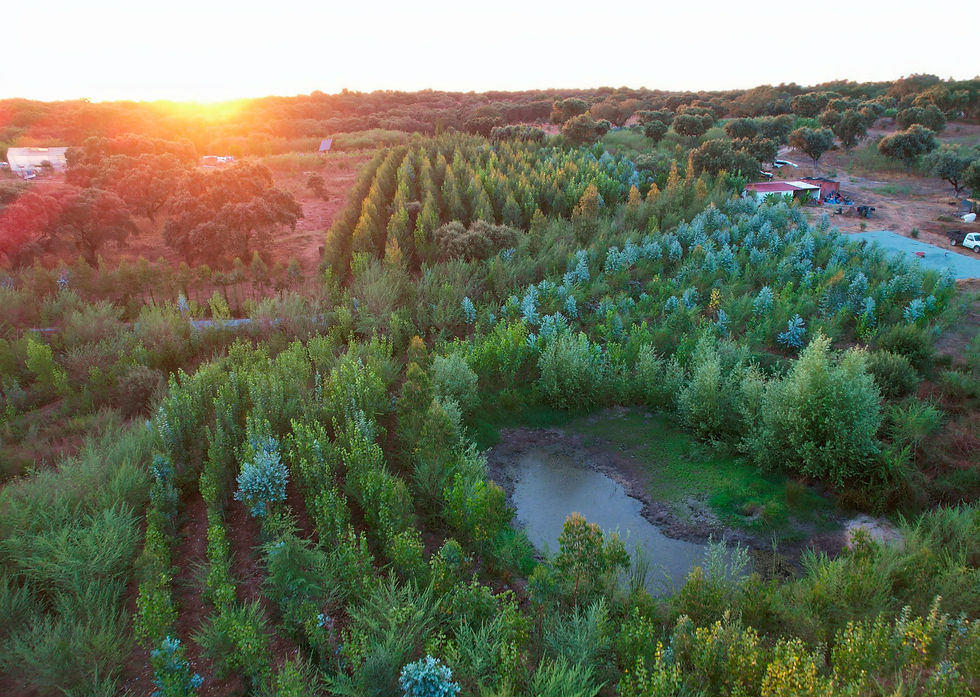


Marc Leiber, a Dutch farmer based in Portugal, transformed six hectares of barren granite land into a thriving syntropic food forest at Quinta das Abelhas, now a living reference for regenerative agriculture in the Mediterranean.
Farm facts
Farm located in
Portugal

Hectares
6
Time invested
6-10 years
Team size
1-5
Crops
Cereals/Grains, Maize/Corn, Root Crops (Potatoes/ Beets/ Carrots/ Other Roots), Vegetables (Open Field/ Market Garden), Fruits, Nuts, Grapes / Vineyards, Olive groves, Herbs/ Spices/ Medicinal Plants, Flowers, Grassland/ Pastures/ Hay, Biomass / Energy crops, Other
Animals
None
Distribution channels
Online shop / website, Other
Practices
Minimising soil disturbance (no or reduced tilling), Cover cropping, Agroforestry/ Reforestation/ Rewilding, Composting, Rotational crop management, Others
Certifications
None
Regenerative Journey
Free of chemical/ synthetic inputs
Revenue streams
Seeking the truth
Marc Leiber grew up in the Netherlands, but it was his stepbrother’s permaculture project in Kenya that first planted the seed of agriculture in his mind. At eighteen, he watched his stepbrother’s experiment in regenerative land management take root, and felt something stir. It would take years of searching and questioning before he found his path and built Quinta das Abelhas in Portugal. But one thing was clear, agriculture was where he belonged.
A few years later, his quest began when he enrolled at a Dutch university to study conventional agriculture and learn more about the systematic logic behind modern practices. However, the more he learned, the more he felt troubled. The degree focused on chemical inputs, disconnection from ecological processes, and the slow erasure of soil health. Was this the future?
“I began questioning the system and voicing these doubts during lectures. Many teachers were unable or unwilling to respond, which only deepened my inquiry,” he recalls. Many of his peers also began looking down on him for challenging the norm. “My persistent questioning soon isolated me from classmates,” he says. Though sidelined from those around him, Marc was not silenced.
While navigating the university system, he found a small group of like-minded peers who wanted to explore further, and together they discovered the food forest movement in the Netherlands. “The idea of tree-based, perennial, productive, and resilient ecosystems captivated us,” Marc shares. They started Den Food Bosch, a food forest near the university that grew into something real: volunteering events gathering 40 to 60 participants to plant and tend local forests. Despite all of the progress, Marc began questioning again. “I felt there had to be a way to design a more efficient system that was managed for productivity rather than treated as a semi-wild reserve where the only human role was harvesting.”
So he kept searching for an agricultural approach that aligned with him.
That’s when he met Ernst Götsch, a Swiss farmer and researcher living in northern Brazil and an avid advocate for syntropic farming. The connection was instant, and he spent days learning from Ernst and showing him his food forest project. “During the four days we spent together, I learned more about the direction of my life path than I had in two years of university before,” he explains. “It felt like coming home.”
Syntropic farming aligned with what Marc had been searching for: a productive system designed with ecological logic at its core, where human intervention enhances rather than depletes. Eager to apply these methods, and unsatisfied with the developments in traditional agriculture in the Netherlands, Marc set out to start his own farm in a more challenging climate. “When I was 24, I started Quinta das Abelhas. Since then, I’ve been working closely with Götsch to develop a leading European space for research, education, and demonstration of his form of agriculture,” he states.
Re-invigorating the land in Portugal
When Marc arrived in southern Portugal, the land he had chosen to build a syntropic farm was desolate. The granite bedrock, the decades of overgrazing, the near-total absence of organic matter made this, in the locals’ minds, a lost cause. “Native vegetation survived only as scattered oaks and struggling shrubs among sparse, poor pastures,” he shares. Undeterred, and fuelled with determination, six years later Marc proved them wrong.
Quinta das Abelhas now manages three of its six hectares in stratified syntropic agroforestry, hosting 150,000 trees and shrubs. Stone fruits, citrus, olives, figs, grapes, and walnuts grow intercropped with native forest species. Each element supports the others: fast-growing support species like tagasaste and eucalyptus create early shade and biomass for slower trees. In the alleys between pruned tree rows, cereals and vegetables are cultivated to maintain soil cover and early productivity. The system is designed not just to produce food, but to generate fertility: to give more to the land than it takes.
After two years, the results were already apparent. Barren fields became dense green corridors. Surface runoff has nearly disappeared. Soil organic matter is rising and the natural spring at the heart of the farm has risen in water level. “Today,” Marc says, “the land is no longer eroding, but generating fertility.”
The farm operates on a diversified revenue model: tree nursery sales, workshops, guided tours, consultancy, off-site project management, an online shop, and donations. Further financial support will help prioritize three key projects: water retention infrastructure, farm processing and accommodation facilities, and further agroforestry plantations.
A Space to Learn Together
Quinta das Abelhas is also a place for others to learn and cultivate best practices, a value that has stayed with Marc from the beginning. What draws people in is not just the method, but the invitation to participate in something alive and unfinished. Marc is deliberate about why this matters beyond his own six hectares. Regenerative agriculture, in his view, is not a fixed recipe; it is a set of principles that each person adapts to their own land, climate, and context. Every farmer brings their own solution, their own creative signature. “I find it so enriching and beautiful,” he says, “to see how all of these people are independently creative in solving their problems in their surroundings.”
“My role keeps evolving from planter to forest manager, trainer, and collaborator, helping others adopt similar strategies toward a more abundant future,” he says. Hundreds of people have passed through: workshops, volunteering events, guided tours, student visits. “In one five-day volunteering event, 20 people planted over 50,000 tree seedlings. This is how the farm grows, through community” says Marc.
It is this belief in shared knowledge that drives his desire to connect with a wider community. “I would really like to be part of the Top 50 Farmers community because I truly believe that these types of experiences are most valuable when shared,” he says. “There is so much value in communicating and networking with different farmers practicing regenerative agriculture, people with similar goals, but different approaches.”
Looking ahead to a bright future
In 10–20 years, Quinta das Abelhas will be a mature, self-regulating food forest. A research and training centre on site will support new techniques and open the door for others to not only learn, but test on the ground. Former interns and students will lead their own projects across the Mediterranean, forming a growing network of practitioners expanding syntropic methods beyond Portugal.
“My vision is to see a landscape that embodies the living principles of syntropy: a place where life organizes itself in patterns of increasing complexity, abundance, and beauty,” Marc says. “Where every decision is documented and every system is observed and refined for the betterment of the land.”
What began as a search for belonging in the world of agriculture led Marc to regeneration in the hills of southern Portugal. He arrived, and he knew. Regeneration is not only a biological process, it is a cultural one. And now, finally, there is no more questioning, but expansion of what he believes in.
Written by Top 50 Farmers and Juliana Bonnattos
Their story
The farm


