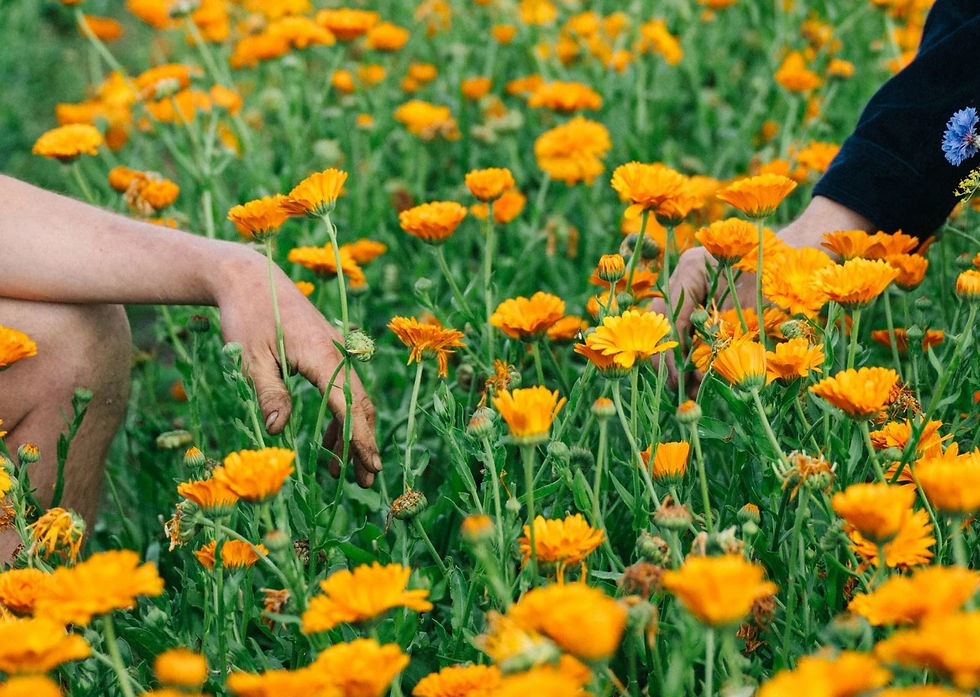


Reinier Hoon runs Goutte, a 6-hectare regenerative market garden on the Dutch-Belgian border showing how great flavor unites us all and the power of research and kindness to make a difference in the community.
Farm facts
Farm located in
Belgium

Hectares
4.5
Time invested
1-5 years
Team size
11-20
Crops
Vegetables (Open Field/ Market Garden), Flowers
Animals
Cattle, Chickens
Distribution channels
Wholesaler, Direct to retailer, Direct to restaurants, Farmers markets, Farm shop / On-farm sales
Practices
Minimising soil disturbance (no or reduced tilling), Cover cropping, Livestock integration, Composting, Rotational crop management, Others
Certifications
Organic
Regenerative Journey
Free of chemical/ synthetic inputs
Revenue streams
Turning philosophy into practice
Reinier Hoon’s story is about moving from the world of ideas into action. Trained in philosophy, he turned to regenerative farming because the principles resonated with his ideals. “I wanted to build something real and tangible,” he explains, “where people are understood as part of the living world and the landscape.”
This became the start of Goutte, a regenerative market garden spanning 6 hectares on both sides of the Dutch–Belgian border. Together with a team of 6, Reinier provides local communities with food while bringing together farmers, chefs, and citizens around a shared belief that quality begins with healthy soil and is ultimately expressed through flavor, nutrient density and care.
Reinier grew up in the village of Kanne, in the municipality of Riemst, in the Flemish part of Belgium. As a child, he roamed between nearby farms and his parents’ wine shop while helping tend a 1,200 m² vegetable garden that supplied both his family and local restaurants. This experience cultivated his two great passions: food and justice.
Seeking ways to bring these values into practice, Reinier eventually returned to farming from philosophy. Reflecting on this shift, Reinier explains, “Arguments don’t convince. Seeing the change does.” He does not believe people change through abstract reasoning about how they should live, eat, or relate to the world around them. Rather he believes in leading by example, “I believe in argument through example: in building real, functioning alternatives that people can step into so that the destructive systems they take for granted suddenly become unnecessary.”
During his early years as a farmer, he discovered regenerative agriculture through YouTube and the approach immediately resonated with the way he already understood the relationship between people and land.
Creating a Living Example
Farming on the southern edge of Maastricht, where deep clay-loam soils rest on porous chalkstone bedrock, Reinier sees himself as the steward of a place with a long agricultural memory.
As he explains, “The geographical position here is truly exceptional. Our clay-loam topsoils are amongst the deepest in Western Europe while the porous chalkstone bedrock gives them a strong capacity to both drain and store water." he explains.
Historically, the region was known for its small-scale horticulture where farmers cultivated tiny plots and built fertile soils through organic matter and careful management. This was long before the term “organic” existed. “In our area, the old ways of farming lasted for centuries and shifted only relatively recently, over the last 50 years, towards more conventional, large-scale production.” Reinier explains. “For me, regeneration is not about inventing something new, but reconnecting with a tradition that has only recently disappeared.”
When Reinier and his team started Goutte, all of their rented land had previously been managed conventionally. Rebuilding fertility from the soil up has required a great deal of work, but over the years they have witnessed remarkable changes of the land. The transformation was particularly evident during the first two years. As Reinier explains, “You see the gains in structure, in smell, and in the health of the plants they can sustain.”
One experience in particular has stayed with him.
Along the border of one of Goutte’s oldest fields, a neighboring farmer unintentionally missed two rows while spraying a beet crop. By late summer, the difference was impossible to ignore. While the rest of the field had taken on a pale yellow-green color, those two untreated rows stood tall, vibrant, and healthy. For Reinier, it became a reminder that the health of a landscape cannot be divided by field boundaries.
Research and kindness as the two missing links
When Reinier returned to farming, he felt that the dominant agricultural system was missing two essential ingredients: kindness and research. “Kindness is the source of healing broken relationships within the landscape. Research helps us understand and support that process,” he explains.
By placing flavour at the center of farming, Goutte has attracted collaborators far beyond agriculture, including chefs who share the farm’s commitment to quality and soil health. Acting as a bridge between farmers and restaurants, Goutte demonstrates how agriculture can strengthen life, creativity, and relationships while helping build regenerative networks and institutions.
Goutte is located in an area dominated by conventional farming, where few neighboring farms share the same mission or goals. In many ways, Reinier describes it as a regenerative desert, a place where new models for more generative forms of production still need to be created. His own experience of transforming conventionally managed land was so striking that it led him to seek out a community of like-minded people eager to deepen their understanding of soil health and restoration.
This search has evolved into a research collaboration with Maastricht University, where Reinier recently started a PhD, focusing on cabbage breeding and enhancing genetic diversity. They are also participating in a research project called Radical Starch, which explores soil health and fiber cultivation for applications beyond food. “We are exploring how agricultural fibre waste streams can be transformed into new materials for the farm shop. The farm itself serves as a living laboratory for trials, participatory cabbage breeding and other projects aimed at strengthening genetic diversity,” Reinier explains.
Beyond the farm, Reinier is helping build regenerative networks through the Leve de Jeker / Vive le Geer Foundation, which focuses on the local area’s watershed. He is also a part of the Regenerative Farmers Lab and BioForum Vlaanderen, connecting farmers, researchers, chefs, and citizens around a shared vision for healthier landscapes. At the heart of all these initiatives is the same principle that shapes life at Goutte: kindness. “We are ambitious. The work can be hard, but we have created a culture in which there is always a base layer of safety and care.”
Through all these collaborations, Goutte continues to build a place where the boundaries between food and fibre are softened. As Reinier says, “I imagine vegetables, fibre plants, dye crops, heritage grains and perennials coexisting in one system, forming a landscape where food culture and material culture meet.”
Back to the Roots
In many ways, Reinier never left philosophy behind. Instead, he chose to live it.
His long-term vision is to create a restaurant that reflects the same values that guide Goutte: quality, community and a deep connection to the local land. The vision may be ambitious, but its foundation remains simple – an intuition for healthy food and connecting back to the earth. This was why Reinier chose to join Top 50 Farmers. “I wanted to be part of a community that fosters learning between like-minded people.”
Healthy soils create healthy food. Healthy food strengthens communities and communities become stewards of the landscapes they depend on.
For Reinier, regeneration is not a return to the past, but a renewed relationship with the living world that allows both farmers and chefs to collaborate making healthy, nutritious food through research and a kind approach towards the land. All while knowing that food ultimately drives change.
Written by Top 50 Farmers and Josephine Lau Jessen
Their story
The farm


