

Guernsey is a small island in the English Channel where Sasha Marsh and her partner Jock Pettitt run The Soil Farm, defining a contemporary farming model for food security and local resilience that blends regenerative agriculture, education, and community building.
Farm facts
Farm located in
United Kingdom

Hectares
8
Time invested
1-5 years
Team size
1-5
Crops
Root Crops (Potatoes/ Beets/ Carrots/ Other Roots), Vegetables (Open Field/ Market Garden), Perennial Crops (Asparagus/ Arichoke/ Rhubarb..), Herbs/ Spices/ Medicinal Plants, Grassland/ Pastures/ Hay
Animals
Cattle, Chickens, Pigs
Distribution channels
Farm shop / On-farm sales
Practices
Minimising soil disturbance (no or reduced tilling), Cover cropping, Holistic grazing, Composting
Certifications
None
Regenerative Journey
Free of chemical/ synthetic inputs
Revenue streams
Creating Change for Their Children
Bringing children into the world and being responsible for their wellbeing transformed the way Sasha Marsh and her partner Jock Pettitt thought about food.
Living on the island of Guernsey in the English Channel, Sasha began questioning where her family’s food came from and what kind of food system their children would inherit. “It was initially about feeding our family, but we quickly realized we had to do something for our community so people could access clean, nutrient-dense food. We couldn’t see a future where this wasn’t a necessity,” she explains.
After exploring a number of different approaches, seeking to learn as much as they could, the realisation that healthy functioning soil was the key became the turning point that accelerated Sasha and Jock’s journey into regenerative farming practices.
Guernsey is a 24-square-mile island where most of the food is imported with little to qualify how the food was produced. Sasha set about creating a local alternative to bolster the island’s resilience and food security. “We wanted to create landscapes that are biologically alive, financially viable, and deeply rooted in the community we serve,” Sasha explains. So, she and Jock founded The Soil Farm.
A Farm in the Sea Between England and France
Located close to Guernsey’s coastal cliffs, The Soil Farm operates a multi-enterprise circular business model including a market garden and livestock.
Spanning 13 hectares over several locations, The Soil Farm is employing a range of regenerative practices to protect and rebuild soil health. Despite high start-up costs, limited access to viable land, and little financial support to demonstrate what regenerative agriculture could look like in a local context, they are experiencing results. “We are seeing profound changes in the landscape as we transition away from the conventional practices of the previous tenant.” Sasha shared proudly. “There are more worms, insects, and birds and our pastures are also developing through our grazing, reseeding and biological applications.”
While these changes may seem small, they create a ripple effect throughout the local ecosystems, helping the web of life flourish. In the market garden, Sasha is focused on building a functioning ecosystem, avoiding tilling the soil, minimizing soil disturbance to preserve organic matter, reduce compaction, and lower the risk of erosion.
The Soil Farm uses living pathways to help retain moisture and biological function in the adjoining beds and actively encourage wildlife to populate the 1 hectare space, seeking to build in balance with nature. In their fourth season of managing the market garden beds, the rewards are starting to match the work invested.
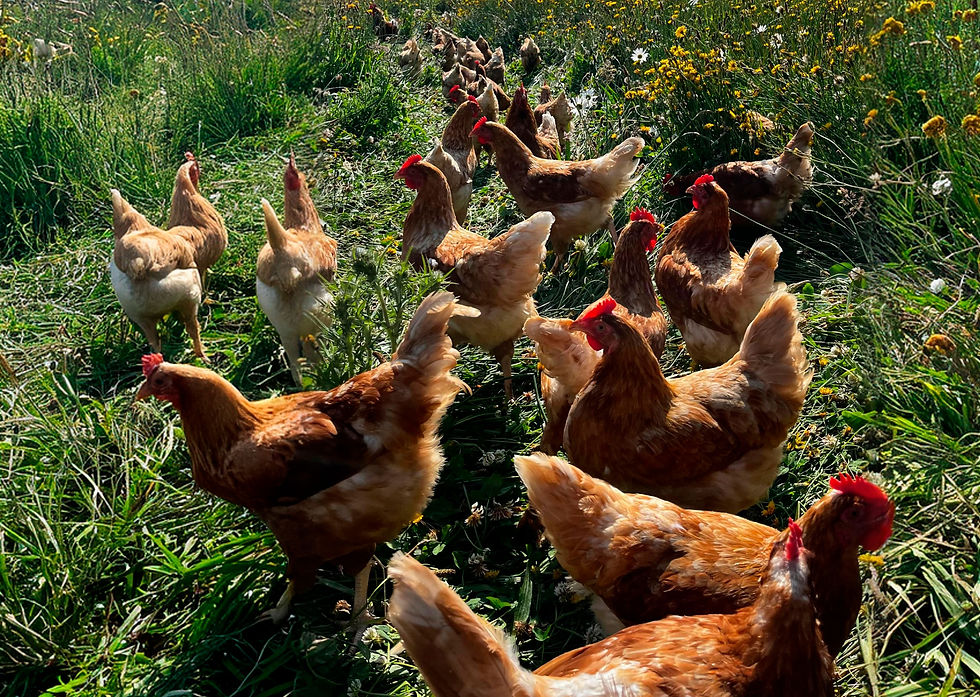
With their flocks of laying hens, pigs and growing herd of Guernsey cows, the farm has gone beyond traditional rotational grazing, adopting holistic grazing practices designed to mimic the way herbivores graze in nature. With the livestock managing the scraps from the market garden and their kitchen, they form an important part of the whole farm system, giving back one of its most important resources, manure.
Sasha will assert without question that their compost production is central to everything they do on the farm, it is the beginning and end of the cycle, keeping vital nutrients cycling through the farm rather than allowing them to leave the farm as waste products and then buying replacements. They produce biologically complete composts, bolstering microbial life and returning nutrients to the soil. Sasha summed up their work quite succinctly, “in essence, we are microbe farmers. If we get that right and get them into our soils, our vegetables, our pastures, our livestock and our customers will pretty much look after themselves.”
Small Island Resilience
The Soil Farm was initially selling direct to customers through a vegetable box scheme, but soon realized the need for a different route to market if their ambition to build a resilient local food sector was to succeed. They founded a sister company, The Farm Shop, which is their primary sales channel and a hub for all local growers working to define standards to sell their products, a vital lifeline for small farms that often struggle to compete with industrialised food systems.
Half of The Farm Shop’s profits are reinvested into developing the local farming sector including land access, grower support, education, and local food security. The farm is organically managed, but chooses not to pursue certification. As Sasha puts it, “We don't feel we need certification to prove anything. We rely on customer trust. We operate with full transparency, welcoming people onto the farm and encouraging them to ask questions. We know our customers, and they know us.”
This is what regenerative farming is about for Sasha. In addition to improving soil health and producing nutrient-dense food, it is about building resilience on an island that remains heavily dependent on imported food. While Guernsey’s size and geographic isolation present challenges, she believes it also creates a unique opportunity for change. “Guernsey is a small island. Change can happen fast here. We have easy access to the government and are close to our community,” Sasha shares. “We are showing how meaningful change can happen quickly on an island of this size, which is no different really to most towns in the UK and Europe, it is only the water that surrounds us which clarifies the details and the data. Our goal is for Guernsey to produce 30% of its food locally in the next decade.”
To bring this vision to life, The Soil Farm regularly hosts composting workshops, farm tours, tastings, school visits, film screenings and community discussions around food systems, while also using its website and social media platforms as educational tools.
Small Island, Big Future
Sasha recognises that no single farm can achieve systemic change on its own, but a network of multi-enterprise regenerative farms, collaborating with a shared vision can change a community. This is also why she is excited to be part of Top 50 Farmers.
“Change requires collaboration, shared vision and many hands working together,” she says. By engaging with policy, education, local businesses and the public, she is helping to create the cultural and political soil in which regenerative agriculture can take root and flourish.
“Our long-term vision is bigger than a single farm,” she says. “It is a collaborative network of regenerative farms within the community growing food that nurtures the land and supports the wellbeing of people. It’s about small farms being valued and supported.” In proving that meaningful change can happen on an island of just 64,000 people, The Soil Farm shows that small farms can make a big difference.
Written by Top 50 Farmers and Marie Lehmann
Their story
The farm


