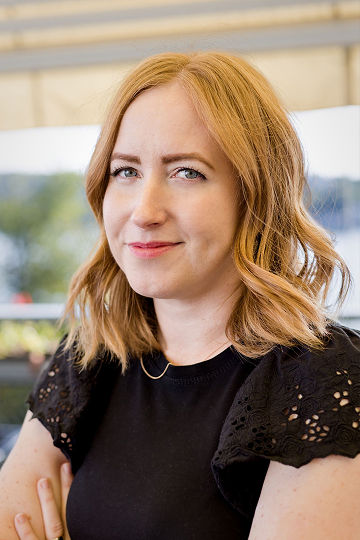
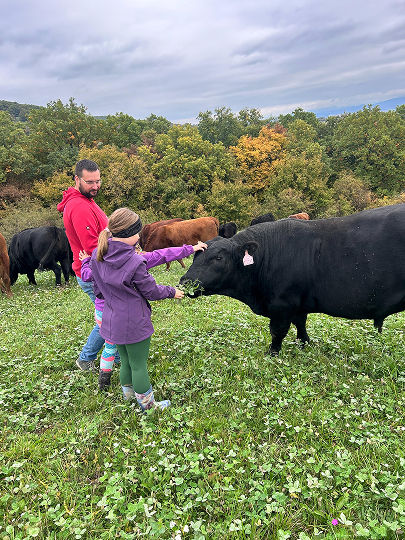
At MERKUJ, a 30-hectare farm in Slovakia's White Carpathians, Tatiana Mudráková, her husband Maroš, raise Aberdeen Angus through adaptive grazing proving regenerative farming is possible alongside full-time corporate careers in R&D and Mathematics.
Farm facts
Farm located in
Slovakia

Hectares
30
Time invested
1-5 years
Team size
1-5
Crops
Grassland/ Pastures/ Hay
Animals
Cattle
Distribution channels
Other
Practices
Minimising soil disturbance (no or reduced tilling), Cover cropping, Holistic grazing, Livestock integration
Certifications
Regenerative Organic
Regenerative Journey
Free of chemical/ synthetic inputs
Revenue streams
The Farm They Never Meant to Build
Four years ago, during Tatiana Mudráková's maternity leave, the beginnings of her family's farm took root. "A developer wanted to build a house in front of us," Tatiana explains of what set them down the path that ultimately became their farm, MERKUJ.
Rather than let an unknown developer disturb their quiet corner of the Melčice Valley of the White Carpathians, about an hour's drive northeast from Slovakia’s capital Bratislava, they decided to purchase the land themselves.
They hadn't set out to be farmers. Both Tatiana and Maroš still hold full-time roles outside the farm. She works in Mathematics drawing on her PhD in Cybernetics. He works in R&D, drawing on his master's in automation and robotics. But once they owned the land around their home, they decided to make the most of it.
"It started with us wanting to have two cows to have healthy beef for us and our kids," Tatiana reflects. “That turned into 30 hectares and 34 Aberdeen Angus cows, which we now manage holistically.”
Learning Farming From YouTube
Deciding to raise beef for their family was one thing, learning how to do this practically was a whole other journey. “We had land and no agricultural knowledge.” Tatiana shares. “We looked for other operations in Slovakia to model ourselves after, but couldn’t find anything so we turned to YouTube.”
This was how they discovered Gabe Brown. They were inspired by his approach and decided to build a regenerative farm. It took two years of intensive research before they began building their herd in earnest, starting with a fence built from the instructions of an Australian YouTube channel.
“In the beginning, we knew nothing about soil, biodiversity and regenerative agriculture. We didn't understand what was in soil. We just trusted the process as we trust the Pythagorean theorem.” Tatiana recalls. “We truly are self-taught YouTube farmers!”
R&D Meets Regenerative Farming
The first five cows arrived at MERKUJ in autumn 2023 to graze two hectares. Within six months, they had expanded to ten hectares and added six more cows. In 2024 they invested in six breeding heifers. Today, they manage 34 Aberdeen Angus through adaptive grazing across 30 hectares. "We are consistently converting more land in our area to regenerative,” Tatiana shares. “We just took over another plot that was managed conventionally.”
This expansion and conversion is far from the only thing Tatiana and Maroš have been doing. Alongside running the farm and being active members in both regional and national young farmers groups, the couple maintain their day jobs in R&D and Mathematics.
"We combine our knowledge from R&D and Mathematics with our farm," she says. “We track changes through observation, photo and video records, and farm management software. We’re also seeking partnerships with universities to deepen what we can measure. Our goal is to produce breeding heifers and seed bulls. By digitalization, we are able to choose the best cows for grazing on pastures. We combine genetics, stats and biodiversity to breed top animals.”
The family's next step is to build a slaughterhouse on-site, with facilities for aging their own beef. Whatever is not usable for the best breeding line will be process for regional beef.
A Vision for the Region
Tatiana and Maroš' hopes MERKUJ can be a lighthouse for raising awareness about regenerative practices in Slovakia. "Being part of Top 50 Farmers gives us a chance to spread our knowledge and support young farmers to enter this profession.”
“Regenerative agriculture is a huge opportunity. Not just for us, but for every farmer, to bring life to our soil and produce healthy food,” Tatiana continues. "Our long-term vision is to create an educational center about regenerative agriculture in Slovakia and a regional market for farmers from the region."
It's an ambitious vision, but Tatiana is clear-eyed about what it takes to get there. "We are not dreamers," she insists. "We need to keep the balance in the triangle of social, environmental and financial factors."
For her, proving that regenerative farming can be genuinely viable in a Slovakian context is the first step toward convincing other local farmers to try it themselves—and toward building the kind of regional knowledge hub she and Maroš couldn't find when they were starting out.
Passing It On
What began as a move to keep developers at bay and put healthy beef on the family table has, four years on, become something much bigger: a working example of what's possible when two people with no farming background decide to learn anyway.
And the next generation is already paying attention.
"I like to help my parents with cows. We love cows!" her daughters announce happily. They’re now growing up not just eating food from their own land, but understanding exactly how it got there. For Tatiana and Maroš, that hands-on knowledge is a privilege they want to extend far beyond their own kitchen table.
Written by Isabel Duncan
Their story
The farm